How many items should be on a dessert table?
A well-built dessert table needs 5 to 7 distinct item types, with a total piece count of roughly 1.5 to 2 pieces per guest — primarily because variety drives visual impact while per-piece count prevents waste. For 100 guests, that typically means 150–200 individual pieces spread across those 5–7 formats. Get either number wrong and the table either looks sparse or runs short before the reception ends.
How many desserts should be on a dessert table by guest count?
Guest count is the primary multiplier for every quantity decision on a dessert table. A table for 50 guests needs far fewer total pieces than one for 150, but the number of item types stays roughly constant — 5 to 7 formats — because variety is about visual fullness, not headcount. What scales with guests is how many pieces of each type you set out, and how often the team refreshes the display mid-reception.
| Guest count | Recommended item types | Total pieces (1.5–2× rule) | What moves the quantity |
|---|---|---|---|
| Up to 50 | 5 types | 75–100 pieces | Whether dessert replaces plated dinner dessert |
| 75 guests | 5–6 types | 115–150 pieces | Cocktail-hour grazing vs. post-dinner service |
| 100 guests | 6 types | 150–200 pieces | Whether a wedding cake is served alongside |
| 150 guests | 6–7 types | 225–300 pieces | Table refresh schedule, dietary variety needed |
| 200+ guests | 7 types | 300–400 pieces | Multi-station layout vs. single table footprint |
One planning note that surprises a lot of couples: if a wedding dessert table is running alongside a full wedding cake, you can trim the per-person piece count closer to 1.2 rather than 2, because the cake slices absorb a significant share of the sweet appetite. We build this adjustment into every quote automatically.
What should a dessert table include?
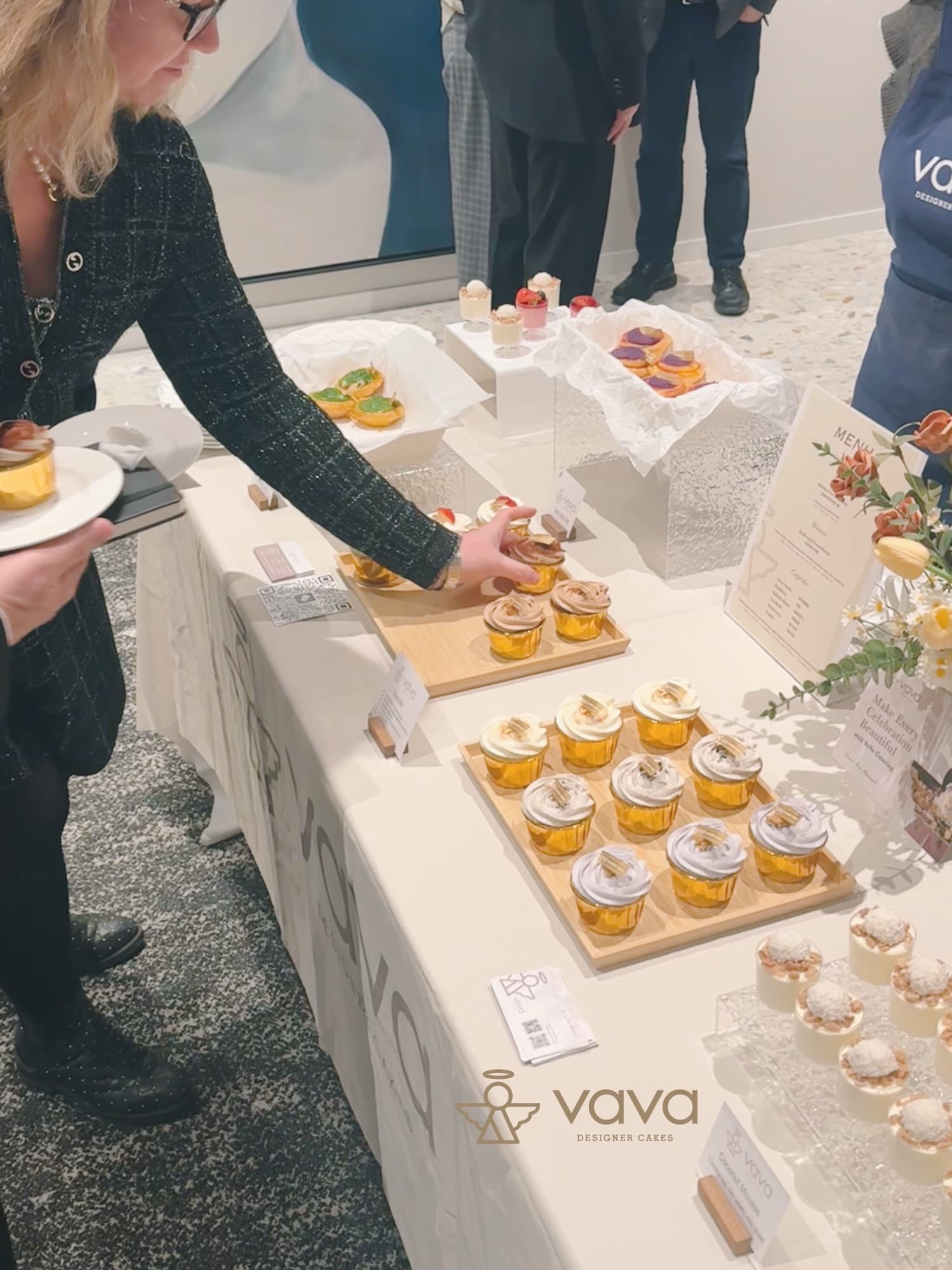
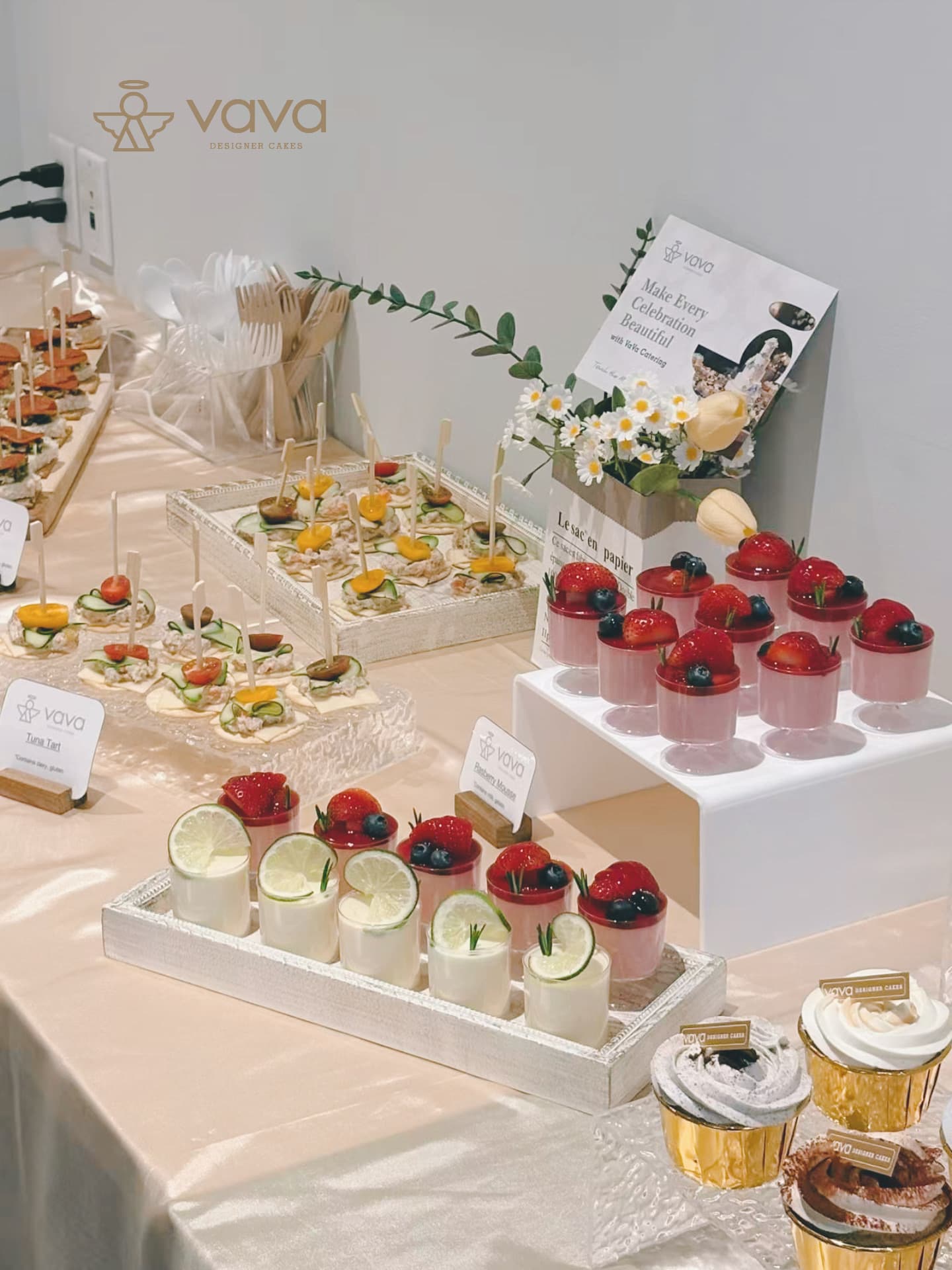
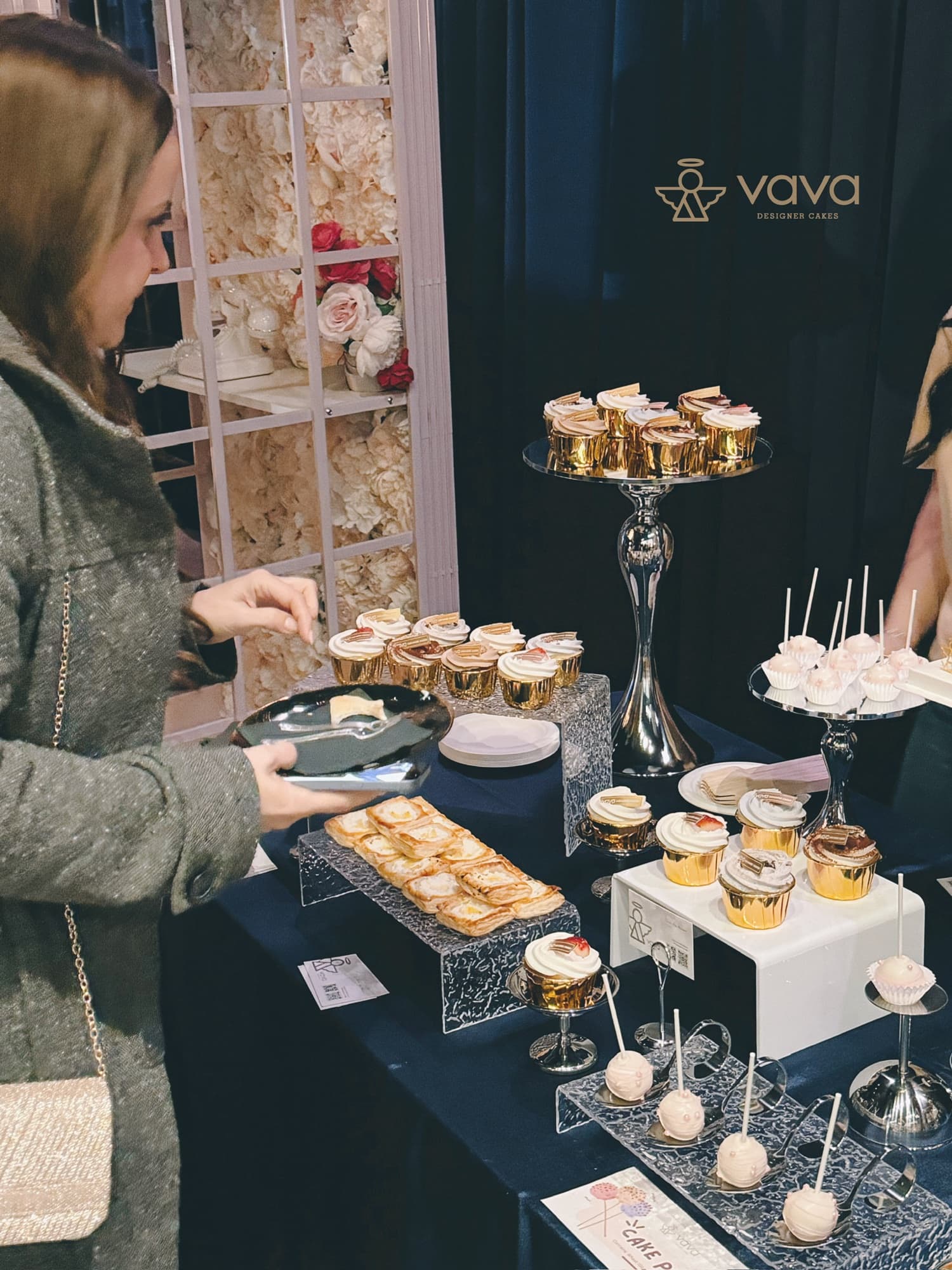
Three structure layers make a dessert table work: a hero item (tall, visual anchor — a macaron tower or tiered mini chiffon display), mid-height items (tarts, mousse cups, cake pops), and ground-level fillers (truffles, chocolate bark, petit fours). Without all 3 height layers, the table reads flat in photos regardless of how many pieces are on it.
Here is the item-type framework we use across our custom dessert table builds in the GTA:
- 1 hero statement piece — macaron tower, mini chiffon cake tier, or croquembouche
- 1–2 bite-sized pastry formats — mini tarts (lemon curd, fruit, ganache) or éclairs
- 1 creamy/mousse format — mousse cups, panna cotta shots, or verrine
- 1 cookie or confection format — macarons loose, shortbread, or decorated sugar cookies
- 1 chocolate element — truffles, chocolate bark, or bonbons
- 1 seasonal or signature item — matched to the event palette and month (strawberry tarts in June, salted caramel cups in November)
- Optional: 1 savoury accent — cheese board corner or savoury profiteroles, especially popular at corporate events in North York and Mississauga
Honestly, the seasonal or signature slot is the one most DIY planners skip — and it's the item guests remember most. A colour-matched mousse cup in the exact dusty rose of the wedding palette does more visual work than doubling the macaron count.
What are the 5 C's of dessert?
The 5 C's of dessert — Colour, Contrast, Composition, Cohesion, and Craft — are the design principles that separate a styled dessert table from a buffet spread. Each C maps directly to a planning decision, not just an aesthetic preference.
- Colour — every item's wrapper, glaze, or garnish pulls from the event palette; we match macarons and mousse cup lids to the couple's exact colour swatch
- Contrast — textures vary (crisp pastry shell beside a silky mousse cup) so the eye moves across the table
- Composition — height varies across 3 tiers; no two tall items sit side by side
- Cohesion — linens, risers, signage, and florals share one visual language; the table reads as a single designed moment, not 7 unrelated desserts
- Craft — finish quality on every piece; a cracked macaron shell or smeared glaze undermines the whole display
When couples ask us why their Pinterest-inspired DIY table "didn't look like the photo," it's almost always a Cohesion or Composition gap — the items were fine individually, but the risers, linens, and spacing weren't designed together. That's the core of what our styled sweet table service solves.
How to elevate a dessert table without adding more items
Three structural moves lift a dessert table's visual impact without increasing the piece count or item variety. Most guides focus on adding more — more items, more tiers, more florals — but the highest-impact changes are subtractive or relational: editing what's already there rather than piling on.
- Vary riser heights by at least 3 distinct levels — low (0–3 inches), mid (6–9 inches), tall (12–16 inches) — so the table has a skyline, not a flat horizon
- Replace a generic linen with one that matches the event palette exactly — a colour-matched table runner does more than a floral arrangement at the same cost point
- Schedule a mid-reception refresh — our team re-styles and replenishes the table between cocktail hour and dancing, so it looks full and intentional in the late-night photos, not picked-over
- Add signage with item names and flavours — small tent cards in the event font; guests linger longer and try more items when they know what they're eating
- Cluster by colour, not by type — grouping all the blush-toned items together creates a gradient effect that reads beautifully in wide-angle venue photography
The mid-reception refresh is the move competitors almost never mention, and it's one of the reasons we include on-site staffing in our dessert catering packages — a table that's been grazed for 90 minutes needs active restyling, not just refilling.
What actually moves a dessert table quote?
Three factors compound to determine what a dessert table quote is built from — and understanding each one helps you make smarter decisions before you contact a vendor. Most buyers focus on guest count alone, but variety depth and on-site service are often larger cost drivers.
- Guest count — sets the base piece count; the 1.5–2× multiplier scales total items directly
- Item variety depth — 7 types vs. 5 types means more production runs, more packaging, more setup complexity
- Styling and rentals — custom risers, colour-matched linens, branded signage, and florals are a separate layer from the food itself
- Delivery, setup, and teardown labour — GTA venue logistics vary significantly; a 30th-floor Yorkville ballroom and a Markham banquet hall have very different setup windows
- On-site service hours — a team that refreshes and re-styles mid-reception costs more than drop-and-go delivery, but the table looks completely different at hour 3
- Dietary requirements — nut-free, gluten-free, or vegan items often require separate production batches, which affects both quantity planning and production cost
If you want a starting point before you reach out for a quote, the most useful number to have ready is your confirmed guest count and whether the dessert table is the primary sweet service or running alongside a wedding cake.
Frequently asked questions
- How many desserts should be on a dessert table?
- Plan for 1.5 to 2 individual pieces per guest across 5 to 7 item types. For 100 guests, that means 150–200 total pieces. If a wedding cake is being served at the same event, reduce the per-person count to roughly 1.2 pieces, since cake slices cover a significant share of dessert appetite.
- What should a dessert table include?
- A dessert table needs 3 height layers — a tall hero item (macaron tower, mini chiffon tier), mid-height pastries (tarts, mousse cups), and ground-level confections (truffles, petit fours) — plus a colour-matched seasonal item. Aim for 5 to 7 distinct formats so the table looks full and visually varied from every angle.
- What are the 5 C's of dessert?
- The 5 C's are Colour, Contrast, Composition, Cohesion, and Craft. Applied to a dessert table: palette-matched items (Colour), varied textures (Contrast), 3-tier height structure (Composition), unified linens and risers (Cohesion), and flawless finish on every piece (Craft). Missing any one of these is usually why a table doesn't photograph the way the inspiration board promised.
- How to elevate a dessert table?
- The 3 highest-impact moves are: varying riser heights across at least 3 distinct levels, swapping a generic linen for one colour-matched to the event palette, and scheduling a mid-reception refresh so the table looks styled — not grazed — in the late-night photos. Adding more items is rarely the answer; editing composition and timing usually is.
- (common question we hear) How many desserts do I need for 75 guests?
- For 75 guests, plan 115 to 150 total pieces across 5 to 6 item types. If the table opens during cocktail hour and stays through dancing, lean toward the higher end — guests return for seconds more often when the table is accessible for 3 or more hours. A mid-reception restock keeps the display looking intentional throughout.