Wedding Dessert Table Ideas on a Budget — What Actually Works
Most couples come to us having already Googled "wedding dessert table ideas on a budget" and found the same two things: a Pinterest board full of six-tier macaron towers, and Reddit threads where someone says "just buy Costco cookies." Neither answer is useful. The real middle ground — a table that looks designed, feeds your guests well, and doesn't quietly wreck your catering line — is what this post is actually about.
Here's the thing: budget-conscious dessert tables fail for one of two reasons. Either the variety is too shallow and the table looks sparse by 8 p.m., or the couple over-orders on one statement piece and runs out of money for the supporting items that make a table feel full and intentional. Getting the structure right matters more than any individual item on it.
What to Put on a Wedding Dessert Table — and What to Skip
A well-built wedding dessert table follows a simple hierarchy: one anchor item, two or three mid-tier items, and a handful of small-bite fillers. The anchor draws the eye. The mid-tier items give guests real variety. The fillers keep the table looking full from cocktail hour through the last dance. Skip any one layer and the whole thing reads as incomplete — no matter how beautiful the individual pieces are.
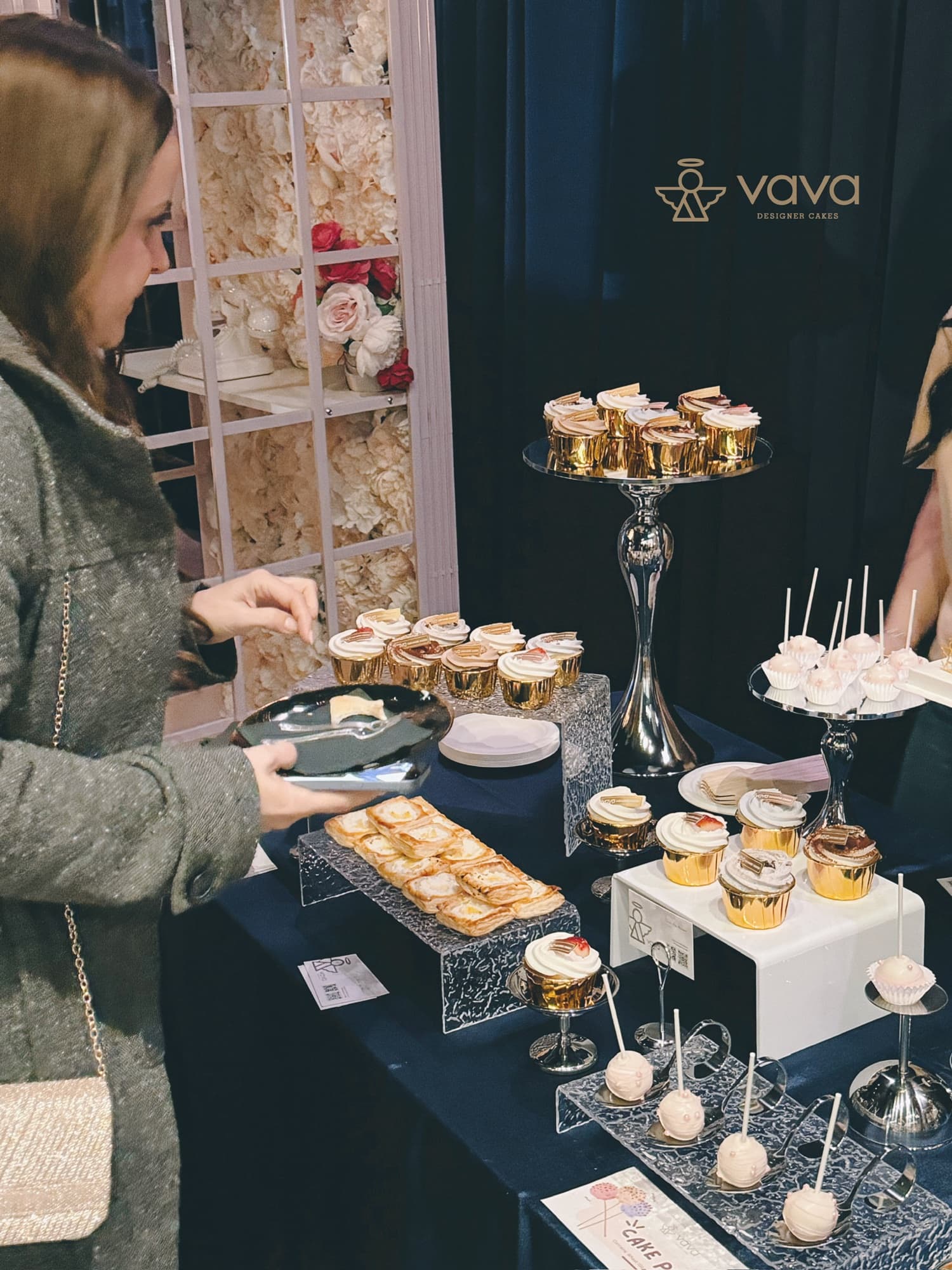
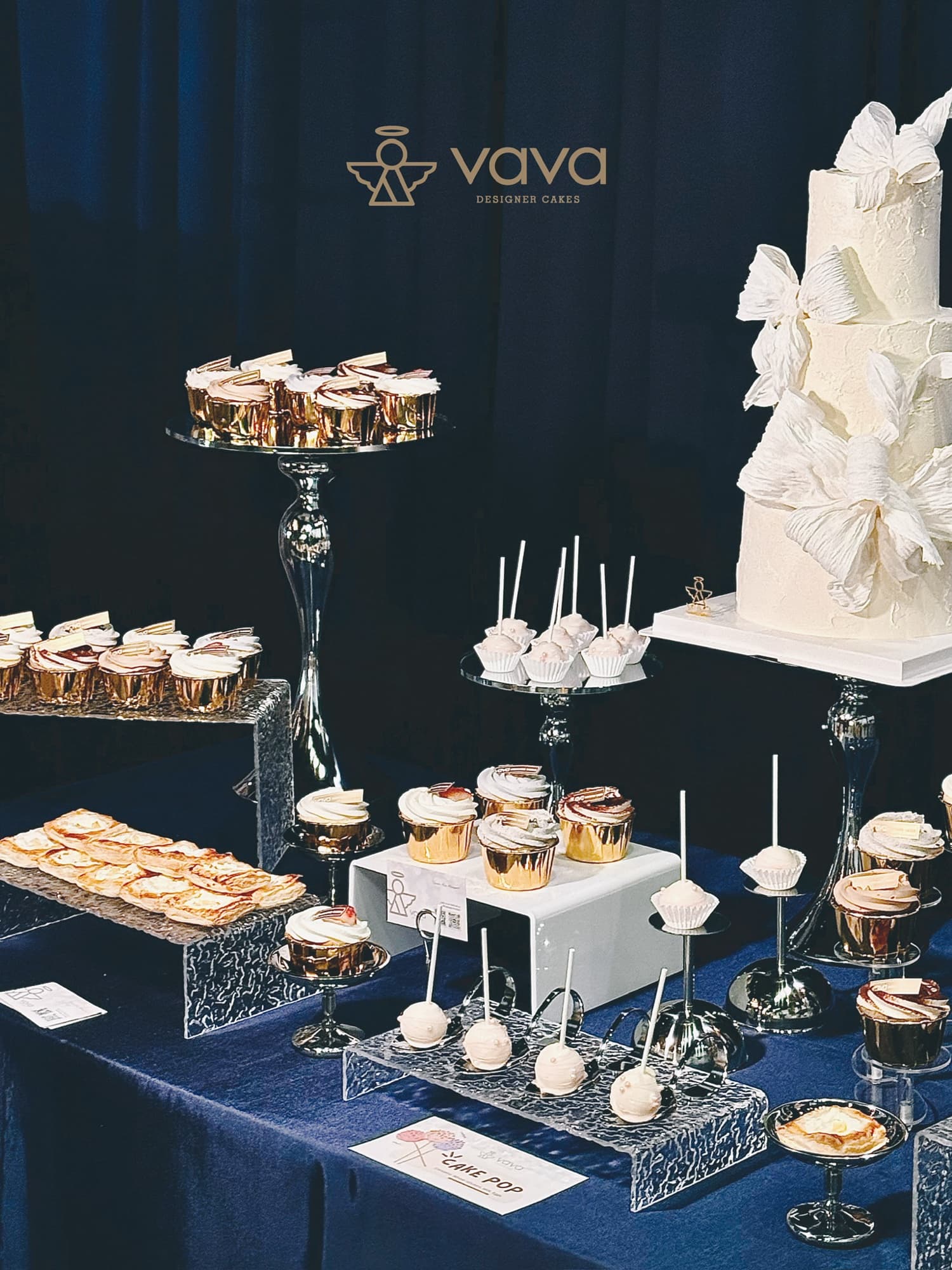
For the anchor, a wedding dessert spread styled around a central cake is the most cohesive option. When the wedding cake and the dessert table are designed together — same colour palette, same flavour family — the entire sweet moment feels intentional rather than assembled from separate vendors. That's the pairing we build with our sister brand VaVa Designer Cakes: one design conversation, one visual result.
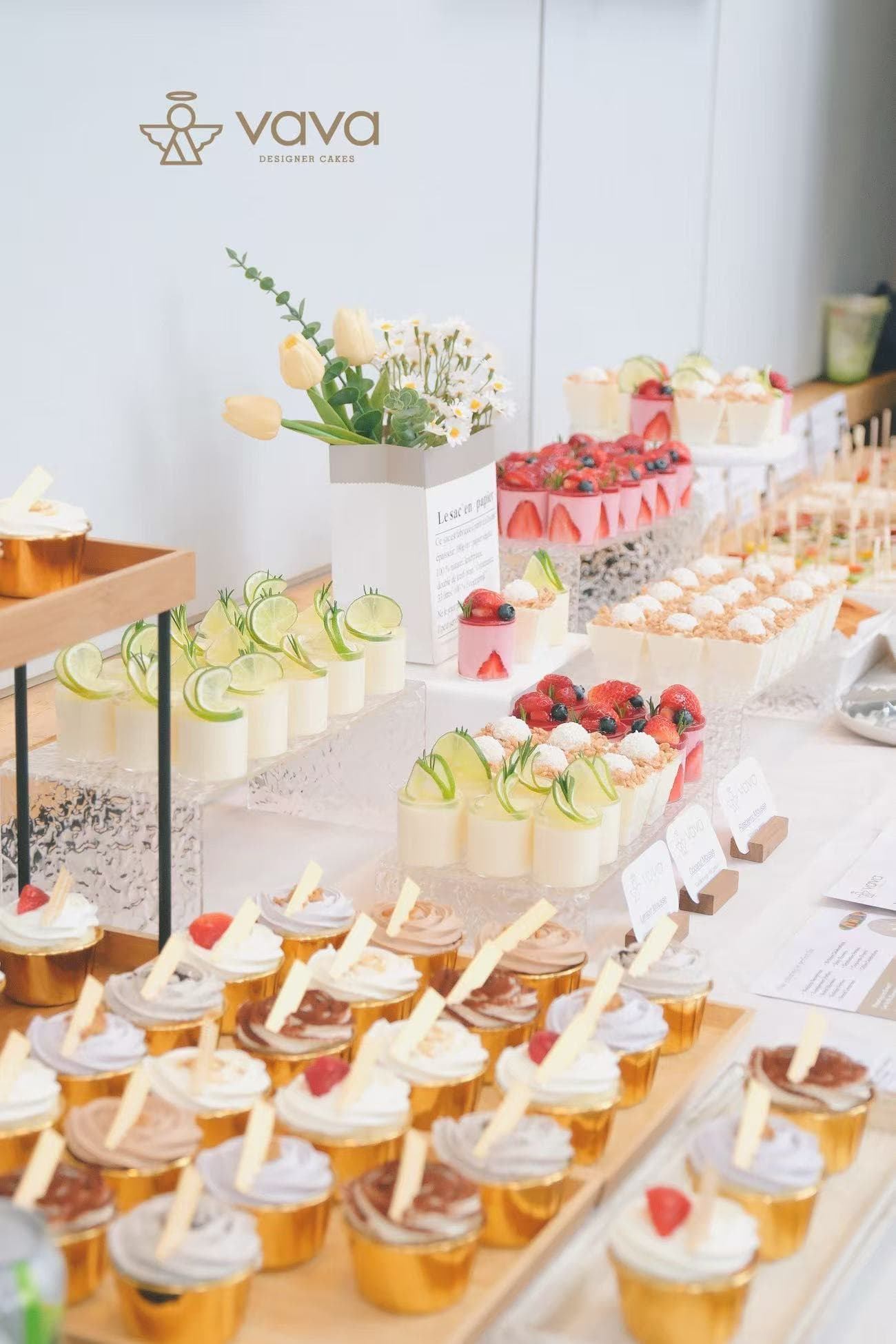
For mid-tier items, mini formats punch above their weight on a budget. Mini chiffon cakes, individual tarts, and small mousse cups each give guests a complete dessert experience without the per-piece cost of a full-size plated dessert. Macarons are a perennial favourite, but honestly, a tray of lemon tarts or earl grey mousse cups often gets more attention — and more compliments — than a macaron tower that guests are nervous to dismantle.
What to skip: anything that requires real-time assembly or refrigeration beyond what your venue can handle. Whipped cream desserts that sit for three hours at room temperature, or anything with fresh-cut fruit that oxidizes under event lighting — these are the items that look great in planning and disappoint in execution.
Simple Wedding Dessert Table Ideas That Still Look Elegant
Simplicity and elegance aren't opposites — they're the same thing when the styling is intentional. The most common mistake on a budget dessert table is trying to fill space with variety when height and colour discipline would do the job better. A table with five well-chosen items on varied risers, in a tight two-colour palette, reads as more sophisticated than a table with twelve items scattered at the same height in four different colours.
Three principles that consistently produce elegant results without adding to the item count:
- Work in odd numbers. Three riser heights, five item types, seven serving vessels — odd groupings feel curated rather than catalogued.
- Match your linens to one colour in your florals, not to the desserts themselves. This anchors the table to the room without requiring every dessert to be dyed or decorated to match.
- Use negative space deliberately. A half-empty tray looks like it's running out. A tray that was intentionally half-filled from the start, with a small floral sprig beside it, looks styled.
- Repeat one texture. Rattan, marble, or mirrored surfaces repeated across two or three risers creates visual rhythm without additional cost.
- Limit signage to two or three labels, maximum. Over-labeled tables look like a bake sale. Under-labeled tables feel exclusive and considered.
Colour discipline is the single highest-return investment on a budget table. Choosing a two-tone palette — say, dusty rose and ivory — and holding every element to it (linens, ribbons, dessert garnishes, florals) produces a table that photographs like a styled editorial shoot. We build every custom dessert table around the couple's event palette for exactly this reason.
How Many Desserts Do You Need for 100 Guests?
The single most reliable planning benchmark for a wedding dessert table is 3 to 4 pieces per guest, assuming the table is served alongside a wedding cake. For 100 guests, that means 300 to 400 individual pieces — but the mix matters as much as the total count. A table of 400 identical cookies feeds 100 people; a table of 400 pieces across six item types delights them.
Here's how we typically break down a 100-guest table into a manageable mix:
| Item Type | Suggested Quantity (100 guests) | Role on the Table | What Moves the Quote |
|---|---|---|---|
| Mini chiffon cakes | 50–60 pieces | Anchor / statement item | Flavour variety, custom decoration, dietary versions |
| Individual tarts | 60–80 pieces | Mid-tier variety | Seasonal fruit, custard complexity, size |
| Mousse cups | 50–60 pieces | Mid-tier variety | Flavour count, garnish complexity |
| Macarons | 80–100 pieces | Filler / visual colour pop | Colour matching, custom flavours, packaging |
| Small cookies or biscotti | 80–100 pieces | Filler / late-night grazing | Packaging, labelling, branded wrapping |
The 3-to-4-piece benchmark comes from our own booking data and aligns with what The Knot's wedding food planning guide recommends for self-serve dessert stations. Where couples consistently under-order is on the filler tier — they focus on the anchor and mid-tier items and forget that the table needs to look full at 10 p.m., not just at 6. Fillers are the insurance policy.
One more thing: if you're serving a full wedding cake alongside the dessert table, you can reduce the per-guest piece count to 2.5 to 3 pieces. The cake carries significant volume. If the table is the only sweet offering, stay at 4 pieces per person — guests graze more than you expect.
Wedding Dessert Bar Ideas on a Budget — Where the Quote Actually Comes From
Budget questions are the most common thing we field, and they deserve a real answer. The quote for a wedding dessert catering setup is built in layers, and understanding those layers tells you exactly where you have flexibility and where you don't.
The first layer is the items themselves — the desserts, their ingredients, and the labour to make them. This is the largest component of any quote, and it scales directly with guest count and variety depth. Fewer item types at higher quantities cost less per piece than many item types at lower quantities, because production runs longer on a single recipe. This is the most actionable lever for couples working with a tighter budget: go deep on two or three items rather than wide across eight.
The second layer is styling and rentals. Risers, linens, serving vessels, signage, florals — these are real costs, and they don't scale with guest count the way food does. A beautifully styled table for 50 guests and a beautifully styled table for 150 guests can have very similar styling costs, because the table footprint doesn't change dramatically. This is why styling investment pays off proportionally better at smaller guest counts.
The third layer is delivery, setup, and on-site service. Delivering to a venue in downtown Toronto during a Saturday afternoon in June is a different logistical proposition than delivering to a Vaughan banquet hall on a Tuesday in November. Venue access windows, freight elevator availability, and on-site service hours all affect this layer. Couples who ask their venue coordinator about vendor load-in windows early in the planning process save themselves real headaches — and sometimes real costs.
What moves the quote most dramatically? Three things: guest count (more guests = more pieces = more production), variety depth (more item types = more production complexity), and on-site service duration (a team that refreshes and re-styles the table mid-reception costs more than a drop-and-go setup, but it also means the table looks as good at 9 p.m. as it did at 6). For couples working with a firm budget, the clearest path to a beautiful table is to fix the styling investment, reduce variety depth, and let the piece count scale naturally with the guest list.
Small Wedding Sweet Table Ideas That Work for Intimate Celebrations
Small weddings — 30 to 60 guests — are where dessert tables genuinely shine, and not just because the piece count is manageable. At an intimate scale, the table becomes a focal point rather than a catering station. Guests spend more time at it. They read the labels. They come back for seconds and actually remember what they ate. That changes the design brief entirely.
For a small wedding, we'd suggest resisting the urge to shrink the table footprint proportionally. A full-width table with fewer items, more negative space, and more considered styling reads as intentional. A small table crammed with proportionally fewer items reads as an afterthought. Keep the table size; edit the item count. Thirty guests don't need eight item types — three or four excellent ones, beautifully presented, is the stronger choice.
The other opportunity at smaller scale is customization depth. When you're ordering for 30 guests instead of 150, you can afford to go further on individual item quality — a more complex flavour in the mousse cup, a more intricate decoration on the mini chiffon cakes, a more specific colour match on the macaron shells. Our sweet table service for intimate events often includes a level of styling detail that simply isn't practical at 200-guest scale.
According to a Brides — 2024 American Wedding Study, the share of couples choosing micro-weddings (under 50 guests) has held above 20% since 2022, a significant shift from the pre-2020 norm where intimate weddings were a niche rather than a mainstream choice. In the GTA, we see this reflected in our own bookings: smaller guest lists, higher per-item investment, and a much stronger interest in the styling details that get lost at scale.
FAQ
- What is the cheapest dessert for a wedding?
- Honestly, the cheapest individual item is usually a simple cookie or biscotti — low ingredient cost, high volume, easy to produce. But "cheapest per piece" isn't always the right frame. A table of only cookies reads as under-planned. The most budget-efficient approach is to anchor on one or two mid-complexity items (like mini chiffon cakes or tarts) in high quantity, then fill around them with cookies or macarons. That mix gives you visual variety without the cost of producing six equally complex item types.
- What to put on a dessert table for a wedding?
- A well-structured wedding dessert table needs three tiers: one anchor item (often tied to the wedding cake design), two or three mid-tier items like tarts or mousse cups that give guests real variety, and a filler tier of smaller bites — macarons, cookies, or petit fours — that keeps the table looking full throughout the reception. Styling elements like risers, linens, and labels are part of the table, not extras. The whole thing should read as one designed moment, not a collection of separate trays.
- What are some easy dessert table ideas?
- The easiest tables to execute well are also the most visually consistent: pick a two-colour palette, choose three to four item types you love, and repeat those items in enough quantity to fill the table generously. Mini chiffon cakes, individual tarts, mousse cups, and macarons are all self-contained — no assembly required on-site, no refrigeration drama. Add a linen in your event colour, a few risers at varied heights, and simple handwritten labels. That's a complete, elegant table without complexity.
- How many desserts do I need for 100 guests?
- Plan for 3 to 4 pieces per guest when the dessert table runs alongside a wedding cake, which puts a 100-guest table at 300 to 400 individual pieces. If the dessert table is the only sweet offering (no separate wedding cake), move that to 4 pieces per person. Spread those pieces across at least four item types so the table has visual depth and guests with different preferences are all covered. Filler items like macarons and cookies should make up roughly 40% of the total count — they're what keeps the table looking full late in the reception.
Ready to build a wedding dessert table that actually fits your guest count, your palette, and your planning reality? Get in touch with us — we work with couples across the GTA from Toronto to Markham to Vaughan, and every quote starts with a real conversation about what you actually need, not a package you have to fit yourself into. Browse our full wedding dessert service to see how the cake and the table come together as one cohesive design moment.